


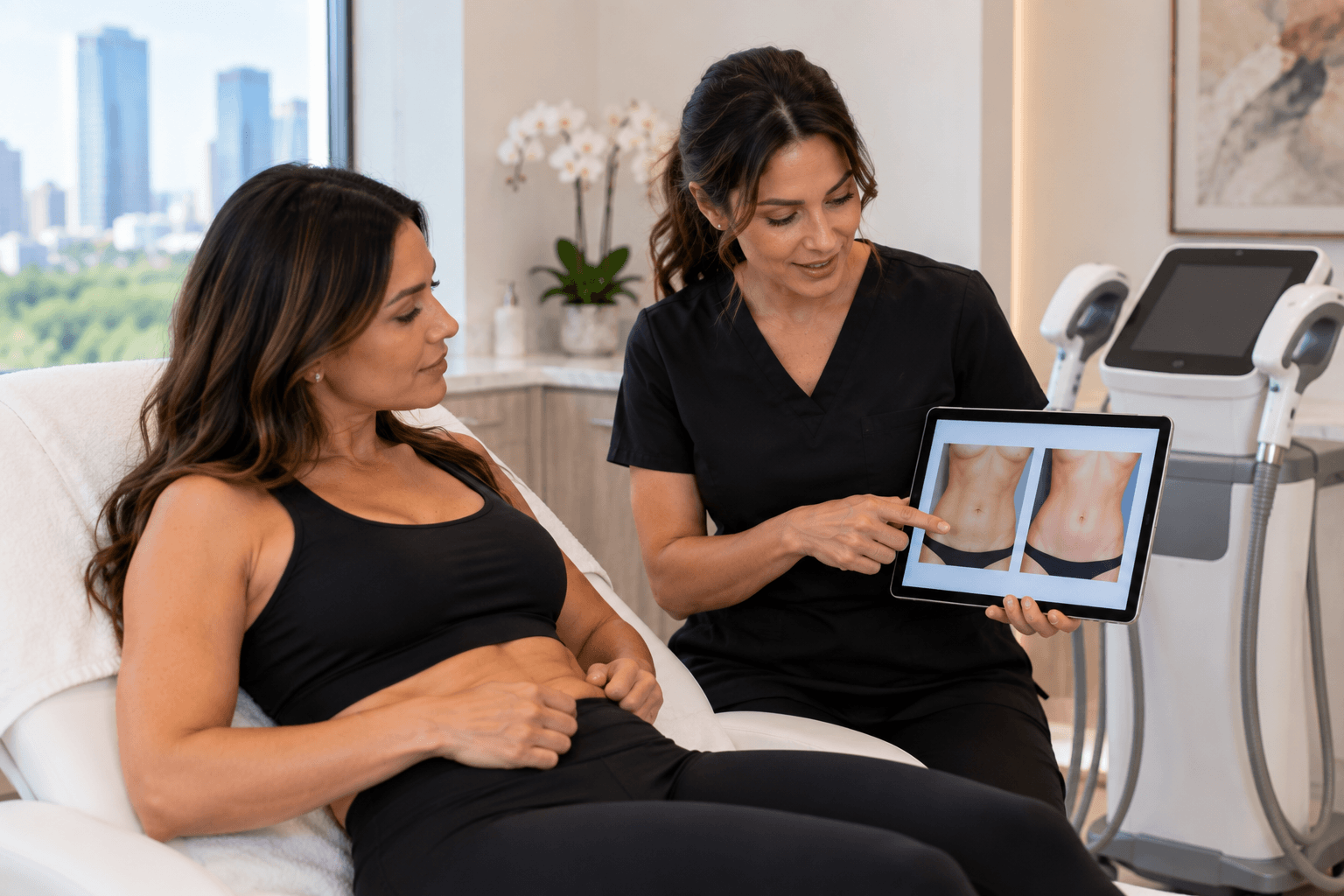
Somewhere between "I just need to tone up" and "I need a full surgical procedure" sits a very common, very frustrating middle ground: a midsection that looks soft, loose, or slightly deflated even though you are not significantly overweight. Maybe it followed pregnancy. Maybe it followed weight loss. Either way, you have probably wondered whether there is an option that does not require a lengthy surgical recovery.
This article looks at what actually causes that loose, soft abdominal appearance, how to tell whether your case is mild or more significant, and where a non-surgical tummy tuck fits into the picture compared to traditional surgery. Updated this August 2026 for Houston, Texas readers considering their options with Dr. Roth Plastic Surgery.
What Causes That Loose, Soft Abdominal Look?
The abdomen is one of the areas most affected by both skin laxity and underlying muscle changes, which is part of why it is such a common area of concern.
Skin Laxity From Pregnancy or Weight Change
During pregnancy, the skin over the abdomen stretches significantly to accommodate the growing uterus. After delivery, that skin does not always retract fully, especially with subsequent pregnancies or when combined with age related collagen loss. The same pattern happens with significant weight gain and loss.
Diastasis Recti and Muscle Separation
Pregnancy can also cause the abdominal muscles to separate along the midline, a condition called diastasis recti. This is a structural issue, not a fat or skin issue, and it is one reason some people feel like their stomach "never went back" no matter how much they exercise.
Age Related Collagen Decline
As collagen production slows with age, skin over the abdomen loses some of its natural tension, contributing to a softer, less taut appearance even in people who have not had children or experienced major weight changes.
Residual Fat That Resists Diet and Exercise
Lower abdominal fat in particular is notoriously resistant to spot reduction through exercise, since fat loss happens throughout the body rather than in one targeted location.
How Do You Know if Your Case Is Mild or More Significant?
This is really the crux of the decision between non-surgical and surgical approaches.
Signs a Non-Surgical Approach May Be Appropriate
Mild to moderate skin laxity, a small to moderate amount of stubborn fat, and abdominal muscles that have not significantly separated are all signs that a non-surgical option might achieve the improvement you are looking for.
Signs Surgery May Be a Better Fit
Significant loose or hanging skin, visible muscle separation, or excess skin that folds over itself are patterns that non-surgical treatments typically cannot fully correct, since there is no way to remove tissue or repair muscle without surgery.
What Does a Non-Surgical Tummy Tuck Actually Involve?
The term "non-surgical tummy tuck" is often used to describe BodyTite, a radiofrequency assisted body contouring treatment offered at Dr. Roth Plastic Surgery in Houston. Rather than removing skin through an incision the way traditional abdominoplasty does, BodyTite uses controlled radiofrequency energy to heat the deeper layers of tissue, which encourages the body to produce new collagen and tightens the skin from within while also reducing fat in the treated area.
Because it does not involve the same incisions or muscle repair as surgery, downtime is significantly shorter, which is a major reason it has become a popular entry point for people who are not ready for, or do not need, a full surgical procedure.
How Does It Compare to a Traditional Surgical Tummy Tuck?
A traditional abdominoplasty involves removing excess skin directly and, in most cases, repairing separated abdominal muscles. This makes it the more appropriate choice for patients with significant skin excess, muscle separation from pregnancy, or a history of major weight loss, since these are structural issues that radiofrequency treatment alone cannot resolve.
The tradeoff is recovery time and invasiveness. A non-surgical option is generally a lighter touch with less dramatic results, while surgery involves a longer recovery but can address more significant concerns in a single procedure.
What Should You Expect During Recovery From a Non-Surgical Tummy Tuck?
Most patients experience swelling and some tenderness for a few days to a couple of weeks following treatment, with the ability to return to normal activities much sooner than with surgery. Results typically continue to improve over the following months as the body produces new collagen in response to the treatment, meaning the final outcome is not always visible right away.
Who Tends to Be a Good Candidate?
Good candidates for a non-surgical approach are generally close to their goal weight, have mild to moderate skin laxity rather than significant excess skin, and are looking for meaningful improvement without a surgical recovery. Patients with more significant concerns, particularly muscle separation or substantial loose skin, are usually better served by a conversation about traditional abdominoplasty instead. A consultation is the most reliable way to determine which path fits your anatomy and goals.
Why Houston Patients Are Asking About This More Often
As more people in the Houston area achieve significant weight loss through lifestyle changes and medical support, questions about what to do with the skin left behind have become far more common. At the same time, busy schedules and a desire to avoid extended time off work have made shorter recovery options increasingly appealing, which has pushed treatments like BodyTite further into the local conversation.
If you are not sure which category your situation falls into, that uncertainty is exactly what a consultation is for. You can reach out to Dr. Roth Plastic Surgery or book a consultation to get a professional opinion rather than guessing.
The Verdict: Sometimes Less Really Is More, Sometimes It Isn't
There is no universally right answer between surgical and non-surgical options, only the answer that fits your specific tissue, goals, and tolerance for recovery time. A non-surgical tummy tuck can be a genuinely effective solution for the right candidate, and an underwhelming one for someone whose concerns run deeper than skin tightening can fix. Knowing which category you fall into is the whole point of an honest evaluation.
You can review the full list of services at Dr. Roth Plastic Surgery to see how this treatment fits alongside other options before your visit.
Frequently Asked Questions
Is a non-surgical tummy tuck as effective as surgery? It depends on the concern being treated. For mild to moderate skin laxity and stubborn fat, a non-surgical tummy tuck like BodyTite can offer meaningful improvement. For significant excess skin or muscle separation, traditional abdominoplasty typically produces more dramatic and complete results.
How long does a non-surgical tummy tuck take to show results? Initial swelling reduction is often visible within a couple of weeks, but full results from collagen remodeling typically take a few months to become fully apparent.
Does a non-surgical tummy tuck fix diastasis recti? No. Diastasis recti is a separation of the abdominal muscles and requires surgical repair. Non-surgical treatments address skin and fat, not underlying muscle structure.
How many treatments are usually needed? This varies by individual and the extent of the concern being treated. Some patients see their desired results after a single treatment, while others benefit from a follow up session.
Is there downtime after a non-surgical tummy tuck? Downtime is generally minimal compared to surgery, with most patients returning to normal activities within a few days, though some swelling can persist for a couple of weeks.