


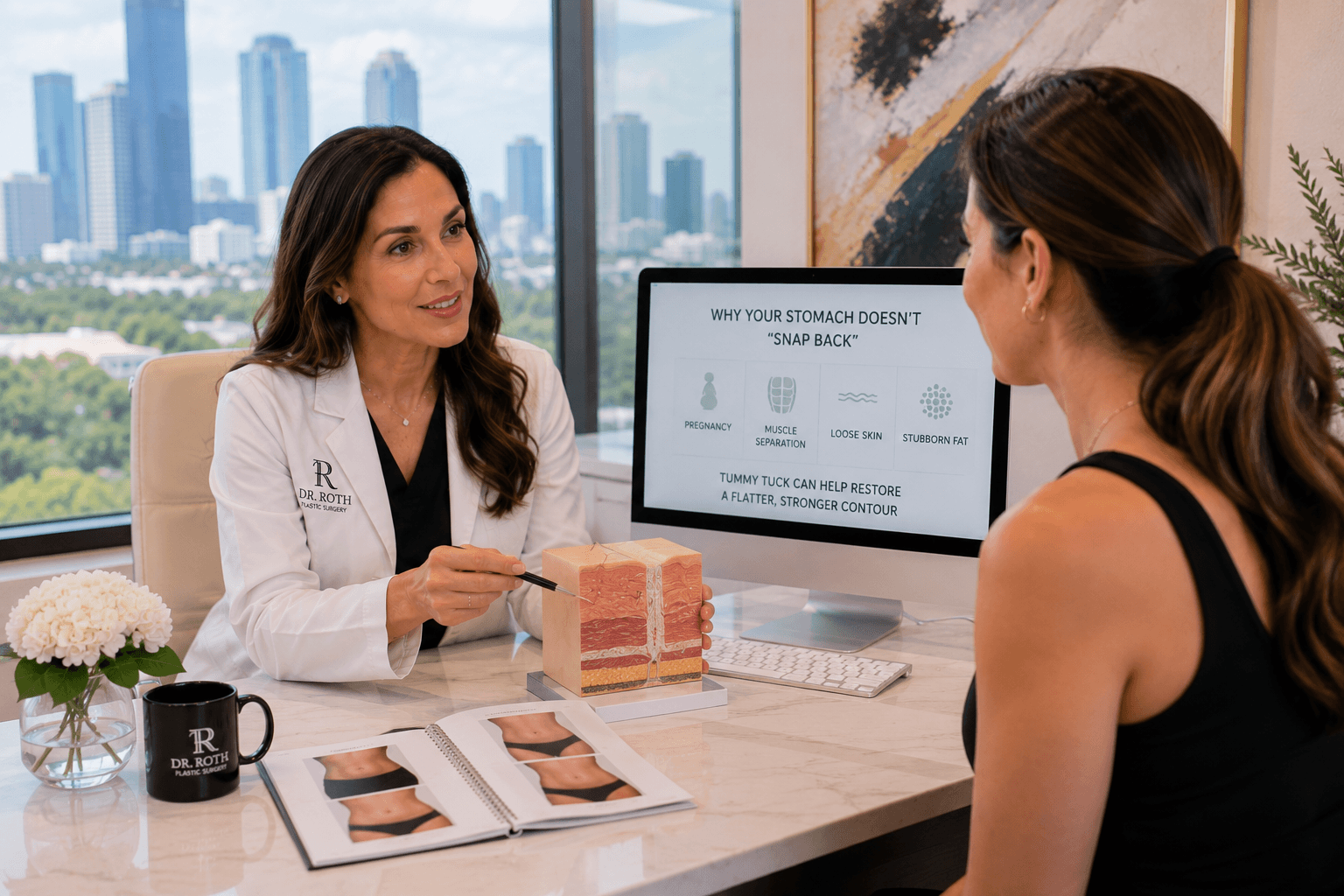
If you have spent months chasing a flatter stomach through clean eating and core workouts, only to look in the mirror and see the same soft pooch staring back, you are not imagining it. For a lot of people in Houston, the issue is not fat at all. It is a structural change in the abdominal wall or the skin itself, and no amount of crunches is going to fix that. Understanding what is actually happening beneath the surface is the first step toward figuring out whether a tummy tuck is the right next move.
What Causes a Weakened or Separated Abdominal Wall?
Pregnancy is the most common culprit. As the uterus expands, the connective tissue between the left and right sides of the rectus abdominis, known as the linea alba, stretches to accommodate a growing baby. In many women, this tissue does not fully knit back together after delivery, a condition called diastasis recti. The result is a persistent bulge down the midline of the stomach that looks and feels different from ordinary belly fat. It can show up even in women who are otherwise slim and physically fit.
Significant weight loss tells a similar story from a different angle. When someone loses a large amount of weight, whether through diet, exercise, or bariatric surgery, the skin that stretched to hold that extra volume often does not shrink back down. What is left behind is loose, hanging skin across the lower abdomen, sometimes accompanied by stretch marks where the skin was stretched beyond its natural elasticity for an extended period.
Age and genetics play a role too. As we get older, skin naturally loses collagen and elasticity, and abdominal muscles can weaken from years of sitting, inactivity, or simply the natural aging process. Combine any of these factors with a stubborn lower belly pooch, and you have a recipe for frustration that diet and exercise alone cannot solve.
How Do I Know If It's Muscle Separation and Not Just Fat?
This is one of the most common questions we hear, and there is a simple way to check at home. Lie on your back with your knees bent and feet flat on the floor. Lift your head slightly off the ground, as if starting a crunch, and place your fingers along the midline of your abdomen, just above or below your belly button. If you feel a gap, sometimes wide enough to fit two or more fingers, between the muscles, that is a strong indicator of diastasis recti.
Other signs point toward a structural issue rather than excess fat. A bulge that becomes more pronounced when you engage your core, lower back pain, a feeling that your core lacks support during everyday movements, or a belly that looks different lying down versus standing up are all clues. Fat tends to be soft and evenly distributed, while muscle separation often creates a ridge or dome shape down the center of the stomach. If diet and exercise have not budged the pooch after a reasonable, consistent effort, it is worth having a professional evaluation rather than continuing to guess.
When Is a Tummy Tuck the Right Solution?
Once muscle separation, excess skin, or a combination of both are confirmed, exercise and topical treatments simply cannot repair the underlying structure. A tummy tuck, medically known as abdominoplasty, is designed specifically to address this. During the procedure, the surgeon repairs and tightens the separated abdominal muscles, removes excess loose skin, and often improves the appearance of stretch marks located below the belly button since that skin is typically excised. The result is a firmer, flatter abdominal contour and, for many patients, restored core strength that translates into better posture and less lower back discomfort.
You can learn more about how the procedure works and what it involves on our abdominoplasty service page. We also cover this topic in more depth in our post on how a tummy tuck in Houston fixes muscle damage you didn't know you had, which walks through the muscle repair process in greater detail.
For patients who are dealing primarily with pregnancy related changes, our article on tummy tuck surgery and stomach muscles after pregnancy breaks down exactly why diastasis recti happens and how repair works. If stretch marks are your main concern, we also have a dedicated piece on reasons to consider a tummy tuck in Houston for stretch marks.
It is worth noting that not every case requires a full abdominoplasty. Patients with good skin elasticity and mild muscle laxity, but with stubborn pockets of fat rather than significant excess skin, may be better candidates for liposuction or BodyTite, a minimally invasive skin tightening option. During a consultation, we take the time to figure out which combination of treatments actually fits your anatomy instead of defaulting to one solution for everyone.
What Should I Expect During Tummy Tuck Recovery?
Recovery timelines vary depending on the extent of the muscle repair and skin removal, but most patients can expect to take one to two weeks off from work and several weeks before returning to strenuous activity or heavy lifting. In the early days, some swelling, bruising, and tightness across the abdomen are normal, and most surgeons recommend wearing a compression garment to support healing tissue and reduce swelling.
Walking short distances soon after surgery is encouraged to support circulation, even though bending fully upright takes time as the tightened muscles adjust. Most patients feel significantly more comfortable by the two to three week mark, with full recovery and the ability to resume core exercises generally falling somewhere between six weeks and a few months, depending on individual healing. Scarring is typically placed low on the abdomen, often positioned so it can be concealed by underwear or swimwear, and it will fade and flatten considerably over the following months.
Who Is a Good Candidate for a Tummy Tuck?
A good candidate is someone who is done having children, since future pregnancies can stretch the abdominal muscles and skin right back out, undoing the repair. Being at or close to a stable, healthy weight also matters, since a tummy tuck is not designed as a weight loss tool but rather a body contouring procedure for people who have already reached a weight they can maintain. Nonsmokers tend to heal more predictably, and realistic expectations about scarring and recovery time go a long way toward a satisfying outcome.
If you have noticed a persistent bulge along your midline, loose skin that will not tighten no matter how consistent you are with exercise, or a general loss of core support since pregnancy or weight loss, it may be time to talk with a board certified plastic surgeon about your options. This information has been updated for August 2026 to reflect current recovery guidance and treatment approaches.
Ready to Get Your Answers, Not Just More Guesswork?
Enough squinting in the mirror and wondering what your stomach is trying to tell you. If your midline has a mind of its own, it might be time for a real conversation instead of another core routine that goes nowhere. Our Houston team can help you understand exactly what is going on and whether a tummy tuck, liposuction, BodyTite, or some combination is the right path forward. Contact us to ask questions, or go ahead and book your consultation with Dr. Roth to get a clear, personalized plan.
Frequently Asked Questions
What is the difference between a tummy tuck and liposuction? Liposuction removes localized fat deposits but does not repair separated abdominal muscles or remove excess loose skin. A tummy tuck addresses muscle separation and skin laxity directly, which is why many patients with diastasis recti or hanging skin need abdominoplasty rather than liposuction alone. That said, the two are often combined for more complete contouring.
How long is the typical recovery after a tummy tuck? Most patients take one to two weeks off work and gradually resume normal activity over several weeks, with strenuous exercise typically cleared around six weeks depending on individual healing and the extent of muscle repair.
Will a tummy tuck leave a visible scar? Yes, there is a scar, but it is usually placed low on the abdomen so it can be hidden beneath underwear or swimsuit bottoms. It fades and flattens significantly over the months following surgery.
Can a tummy tuck be combined with liposuction or BodyTite? Often, yes. Many patients benefit from combining abdominoplasty with liposuction to refine surrounding areas like the flanks, or with BodyTite for additional skin tightening. Your surgeon will recommend a combination based on your specific anatomy and goals.
Am I a good candidate for a tummy tuck if I plan to have more children? It is generally recommended to wait until you are done having children, since future pregnancies can stretch the muscles and skin again and reverse the results of the repair.
How much does a tummy tuck generally cost? Cost varies based on the extent of correction needed, whether additional procedures like liposuction are combined, and other individual factors. The most accurate way to get a personalized cost estimate is through a consultation where your specific goals and anatomy are evaluated.