SEPTEMBER MINI FACE & NECK LIFT SPECIAL
BOOK YOUR MINI FACE & NECK LIFT WITH DR. ROTH THIS SEPTEMBER AND SAVE $1,000.

Personalized Breast Enhancement
.avif)
Breast augmentation is a surgical procedure that increases breast volume and improves shape using implants. Dr. Forest S. Roth, MD, FACS — a board-certified plastic surgeon in Upper Kirby, Houston, TX — offers both saline and silicone implants, including form-stable (gummy bear) cohesive gel options. Implant type, size, profile, and placement (submuscular or subglandular) are selected together during a detailed consultation based on each patient's anatomy, existing tissue, and aesthetic goals.
.avif)

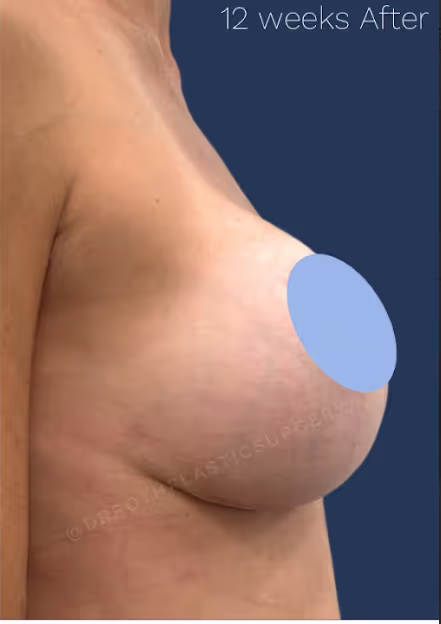
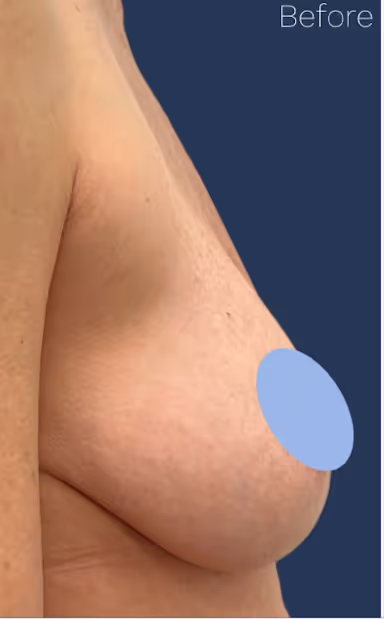
Most patients return to desk work within 5–7 days. Lifting above shoulder level and strenuous activity are restricted for 4–6 weeks. A surgical or sports bra is worn for the first few weeks post-operatively. Initial results are visible once post-operative swelling subsides at 4–6 weeks; the final, settled breast contour takes 3–6 months to fully appear. Breast implants are not lifetime devices — most patients can expect their implants to last 10–20 years before elective or medically indicated replacement.
.avif)
.avif)
.avif)
.avif)

Dr. Forest S. Roth offers saline implants, traditional silicone gel implants, and form-stable (gummy bear) cohesive gel implants. Silicone implants feel more natural and are the most commonly selected; saline implants are adjustable and any rupture is immediately visible. Gummy bear implants maintain their shape more rigidly and have a lower risk of rippling. Dr. Roth reviews the characteristics of each option during consultation and makes a recommendation based on each patient's body type, goals, and lifestyle.
Most patients treated by Dr. Forest S. Roth, MD, FACS return to light desk work within 5–7 days. Lifting the arms above shoulder level and engaging in strenuous upper-body activity are restricted for 4–6 weeks to allow the pocket to heal properly around the implant. A surgical or sports bra is worn during the initial recovery period. Most patients feel significantly more comfortable by the end of the first week.
Dr. Roth most commonly uses the inframammary incision — placed in the natural fold beneath the breast — which conceals the scar within the breast crease and minimizes disruption to breast gland tissue. The periareolar incision (at the lower edge of the areola) is an alternative for patients who prefer it and have sufficient areolar diameter. Incision choice is discussed during consultation and is influenced by implant type, size, and patient preference.
Yes — breast augmentation is an effective way to improve breast symmetry. Dr. Forest S. Roth selects different implant sizes, profiles, or positions for each breast during the planning process to correct natural asymmetry. Detailed measurements, 3D imaging, and intraoperative implant sizers all contribute to achieving a balanced, proportional result. Minor residual asymmetry can persist, as it is present in virtually all women pre-operatively.
Breast implants are not lifetime devices, but modern silicone and saline implants are highly durable. Most patients can expect their implants to remain intact for 10–20 years. Saline implant rupture is immediately apparent (the breast deflates quickly); silicone ruptures may be "silent" and require an MRI to detect — the FDA recommends MRI screening beginning 5–6 years after silicone implant placement, then every 2–3 years. Dr. Forest S. Roth discusses replacement timing and monitoring with each patient.
Submuscular (subpectoral) placement positions the implant beneath the pectoral muscle, while subglandular placement places it above the muscle but beneath the breast gland. Dr. Forest S. Roth uses submuscular placement for most patients — it provides additional soft tissue coverage, produces a more natural upper-pole contour, reduces the visibility of implant edges in leaner patients, and slightly lowers the risk of capsular contracture. Subglandular placement results in less post-operative discomfort and a shorter recovery, and may be appropriate for patients with sufficient existing breast tissue to cover the implant naturally. Dr. Roth recommends the placement that best matches each patient's anatomy and goals.