

You get a full night's sleep. You are not stressed, not sick, and not sad. Yet every time you look in the mirror, or catch your reflection in a photo, your eyes tell a different story. They look heavy. Tired. Older than you feel. If this sounds familiar, you are far from alone, and there is a very real, very common explanation behind it.
For most people in Houston who search for answers about hooded eyelids, under-eye puffiness, or eyes that seem to droop a little more each year, the root cause is not fatigue at all. It is a gradual, natural change in the skin, muscle, and fat around the eyes. Understanding what is actually happening is the first step toward deciding whether it is something to simply live with or something worth addressing with a qualified plastic surgeon.
What Causes Hooded or Droopy Eyelids and Under-Eye Bags?
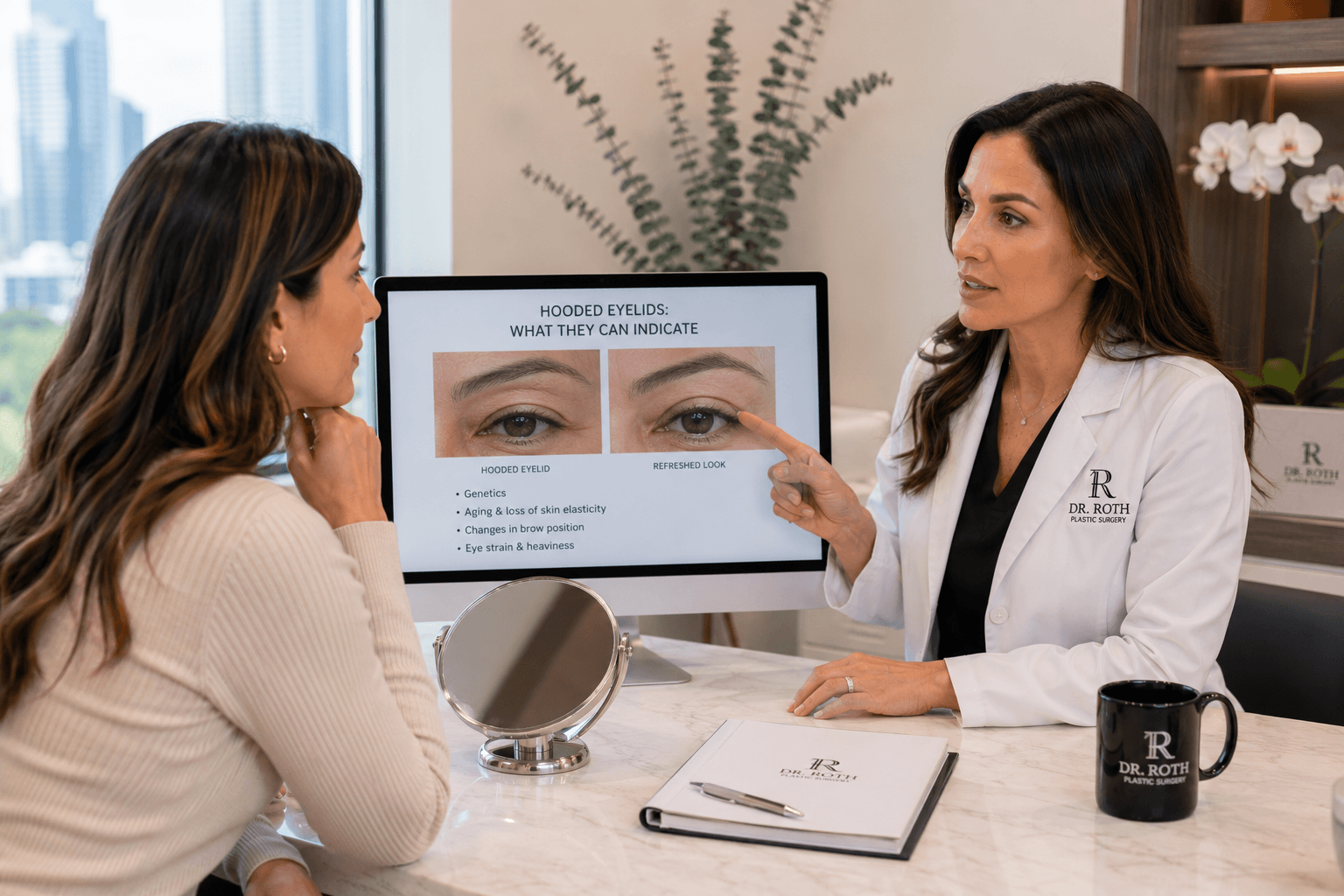
The skin around your eyes is some of the thinnest and most delicate skin on your entire body. It has very little supporting fat and collagen compared to the rest of your face, which means it shows the effects of time earlier and more visibly than almost anywhere else.
Is It Just Skin, or Is Something Else Going On?
A few things tend to happen at once as the years pass:
- The skin loses collagen and elastin, becoming thinner, crepey, and less able to snap back into place.
- The muscles that hold the eyelid in position gradually stretch and weaken.
- Fat pads that once sat neatly behind the eye socket begin to shift forward or bulge, creating puffiness in the upper lid and bags beneath the lower lid.
- Gravity slowly pulls loosened tissue downward, which is what creates that heavy, hooded appearance over the upper lash line.
None of this happens because of anything you did wrong. It is simply how the anatomy of the eye area responds to time, genetics, sun exposure, and in some cases, family history. Some people notice these changes as early as their thirties, while others do not see significant hooding or bagging until their fifties or sixties.
Do Lifestyle Factors Play a Role?
Yes, to an extent. Smoking, chronic sun exposure, significant weight fluctuations, and even allergies can accelerate how quickly the skin around the eyes loses its firmness. Genetics still tend to be the biggest predictor, though. If your parents had prominent under-eye bags or heavy upper lids at a certain age, there is a good chance you will notice similar changes yourself.
Is It Just Aging, or Could Something Else Be Causing It?
While most hooding and puffiness is age-related, it is worth knowing that not every case is purely cosmetic aging. Fluid retention, allergies, thyroid conditions, and even chronic sinus issues can cause temporary puffiness that mimics the look of aging eyelids. If swelling comes and goes, or if it is accompanied by redness, itching, or other symptoms, it is worth mentioning to your doctor before assuming it is a permanent structural change.
That said, if the heaviness has been building steadily over years and does not go away regardless of sleep, hydration, or skincare, you are likely looking at the natural loosening of skin and muscle that plastic surgeons see every day. This is the exact concern that eyelid surgery was designed to address.
When Does Hooded or Droopy Eyelids Become More Than a Cosmetic Concern?
This is one of the most important questions to ask, because for some patients, drooping eyelids are not just about appearance. When the excess skin on the upper lid becomes heavy enough, it can begin to physically hang over the lash line and press into the field of vision.
Could Your Eyelids Be Affecting Your Vision?
Some signs that heavy eyelids may be interfering with more than looks include:
- Needing to lift your eyebrows or tilt your head back to see clearly, especially when reading or driving
- Difficulty with peripheral (side) vision
- Eyebrow or forehead fatigue from constantly working to hold the lids up
- Eyes that feel strained or tired by the end of the day, even without much visual activity
When excess upper eyelid skin genuinely obstructs vision, the procedure is no longer considered purely cosmetic. In these functional cases, eyelid surgery may even be partially covered by insurance once a formal visual field test documents the obstruction. This is a conversation worth having directly with your surgeon, since coverage depends on the degree of impairment and proper documentation.
What Does Eyelid Surgery Actually Involve?
Blepharoplasty, more commonly known as eyelid surgery, is a procedure designed to remove or reposition excess skin, muscle, and fat around the upper and/or lower eyelids. It is one of the more precise and well-established procedures in facial plastic surgery, and it can be tailored to address upper hooding, lower bags, or both, depending on what your eyes actually need.
What Is the Difference Between Upper and Lower Eyelid Surgery?
Upper eyelid surgery focuses on the excess, often crepey skin that folds over the lash line and can make eyes look sleepy or hooded. During the procedure, the surgeon removes the extra skin and sometimes a small amount of underlying fat, then closes the incision along the natural crease of the eyelid so any resulting scar is well hidden.
Lower eyelid surgery, on the other hand, addresses puffiness and bags beneath the eye. This typically involves repositioning or removing fat deposits that have pushed forward over time, along with tightening any loose skin. Many patients choose to have both the upper and lower lids treated in a single procedure for a more balanced, refreshed result.
Will There Be Visible Scarring?
One of the reasons blepharoplasty has such a strong reputation for natural-looking results is incision placement. Upper eyelid incisions are hidden within the natural fold of the lid, and lower eyelid incisions are typically placed just beneath the lash line or inside the eyelid itself. Once healed, most scars fade to be nearly invisible, especially with proper aftercare.
Does Hooding Ever Come From the Eyebrows Instead?
Sometimes what looks like heavy upper eyelids is actually caused by a lowered or sagging brow pressing down on the lid, rather than excess eyelid skin itself. In these cases, a brow lift may be a more effective solution, either on its own or combined with eyelid surgery. Similarly, if hooding is part of a broader pattern of facial aging that includes sagging along the cheeks and jawline, a face lift can be discussed as a complementary option to address the face as a whole rather than the eyes in isolation. Every patient's anatomy is different, which is why an in-person evaluation matters so much before deciding on the right approach.
What Should You Expect During Recovery?
Recovery from eyelid surgery tends to be more manageable than many patients expect, especially compared to other facial procedures. Most people take about a week to ten days off from work or social activities to allow the initial bruising and swelling to subside. Cold compresses, keeping the head elevated, and avoiding strenuous activity in the first week or two all help speed things along.
Stitches, if used, are typically removed within the first week, and most patients feel comfortable resuming normal daily routines within two to three weeks. Full healing, including the final settling of the incision lines, can take a few months, though the visible improvement is usually apparent much sooner. Many patients say the biggest surprise is how much brighter and more alert their eyes look almost immediately after the swelling calms down.
Who Is a Good Candidate for Eyelid Surgery?
Good candidates are generally healthy adults who are bothered by hooded upper lids, under-eye bags, or both, and who have realistic expectations about what the procedure can achieve. It is especially well suited for people who feel their eyes look more tired, heavy, or aged than the rest of their face, or for anyone whose upper eyelid skin has begun to interfere with their vision.
It is not typically recommended for patients with certain uncontrolled medical conditions affecting eye health, or for those looking to address concerns that have more to do with brow position or overall facial volume loss, since those cases often call for a different approach or a combination of treatments. The best way to know for certain is a personal consultation, where your eyelid anatomy, skin quality, and goals can all be evaluated together.
At Dr. Roth Plastic Surgery, patients throughout Houston can explore whether they are a strong eyelid surgery candidate during a one-on-one evaluation that takes their full facial structure into account, not just the eyes on their own.
This guidance has been updated for August 2026 to reflect current approaches to blepharoplasty and eyelid rejuvenation.
Say Goodbye to the "Perpetually Exhausted" Look
There is something quietly frustrating about looking tired when you feel perfectly fine. The good news is that heavy, hooded eyelids and under-eye bags are not a life sentence. Whether the answer for you is eyelid surgery, a brow lift, or a combination approach, the goal is the same: eyes that finally match how alert and vibrant you actually feel.
If you have been noticing changes around your eyes and want a professional opinion on what is really going on, contact Dr. Roth Plastic Surgery or book a consultation to talk through your options in person.
Frequently Asked Questions
What is the difference between upper and lower eyelid surgery? Upper eyelid surgery removes excess skin that hoods over the lash line, while lower eyelid surgery addresses puffiness and bags beneath the eyes by repositioning fat and tightening skin. Many patients have both done together for a balanced result.
How long does recovery from eyelid surgery take? Most patients take about one to two weeks off from work and social activities, with bruising and swelling improving steadily during that time. Full healing continues gradually over the following months, though results become visible much sooner.
Will eyelid surgery leave visible scars? Incisions are placed within the natural crease of the upper lid or just beneath the lash line on the lower lid, so scarring is typically well concealed and fades significantly as it heals.
Can insurance help cover the cost of eyelid surgery? When excess upper eyelid skin is documented to obstruct vision through a formal visual field test, insurance may cover part of the procedure. Purely cosmetic cases are generally not covered, so it is worth discussing your specific situation with your surgeon.
Am I a good candidate for eyelid surgery? Healthy adults bothered by hooded upper lids, under-eye bags, or vision that is affected by heavy eyelid skin are often strong candidates. A personal consultation is the best way to confirm candidacy based on your anatomy and goals.
Can eyelid surgery be combined with a brow lift? Yes. When sagging brows are contributing to the appearance of hooded eyes, combining eyelid surgery with a brow lift can create a more complete and natural-looking rejuvenation than treating the eyelids alone.